Video (above): Mehrdad Farimani examines robot categories, design trade-offs and the rise of hybrid bimanual wheeled humanoids at Humanoids Summit Tokyo 2026.
Video credit: Humanoids Summit YouTube Channel | Watch the original video
By Dan Smigrod, Managing Editor, Humanoid Home News
Mehrdad Farimani used a series of robotics posters at Humanoids Summit Tokyo 2026 to make a broader point about humanoid design: as robots become more versatile, their engineering complexity rises with them. His clearest 2026 prediction was the growth of what he called hybrid bimanual humanoids, machines that combine a humanoid upper body and two arms with a wheeled lower base.
The form factor matters for home robotics because it challenges the assumption that a useful humanoid must walk on two legs. A wheeled platform gives up stairs and some uneven-terrain capability, but it can also simplify mobility and improve stability for indoor tasks where manipulation matters more than humanlike walking.
From specialized robots toward converged platforms
Farimani, identified by the Humanoids Summit agenda as Founder at MERPHI, traced the industry’s progression through posters covering adult-sized humanoids, quadrupeds, research and social robots, industrial arms, cobots, dexterous hands and the history of humanoid development.
His central framework compares versatility with system complexity. Earlier robotics categories were more distinct: autonomous mobile robots handled locomotion, robot arms handled manipulation, and end effectors handled grasping. As companies try to make one machine perform more tasks, those once-separate systems are being combined into increasingly complex platforms.
Farimani argued that this convergence helps explain the appeal of humanoids. A general-purpose robot needs mobility, manipulation and an end effector in one system. But he also emphasized that more humanlike hardware is not automatically better. The appropriate form should follow the work the robot is expected to perform.
Why wheels may make sense in homes
Near the end of the presentation, Farimani previewed a poster devoted to hybrid bimanual humanoids. He described the category as a humanoid upper body mounted on a wheeled base and said many notable examples were appearing in 2026. His poster separated applications into industrial logistics, commercial and home use, research and other categories.
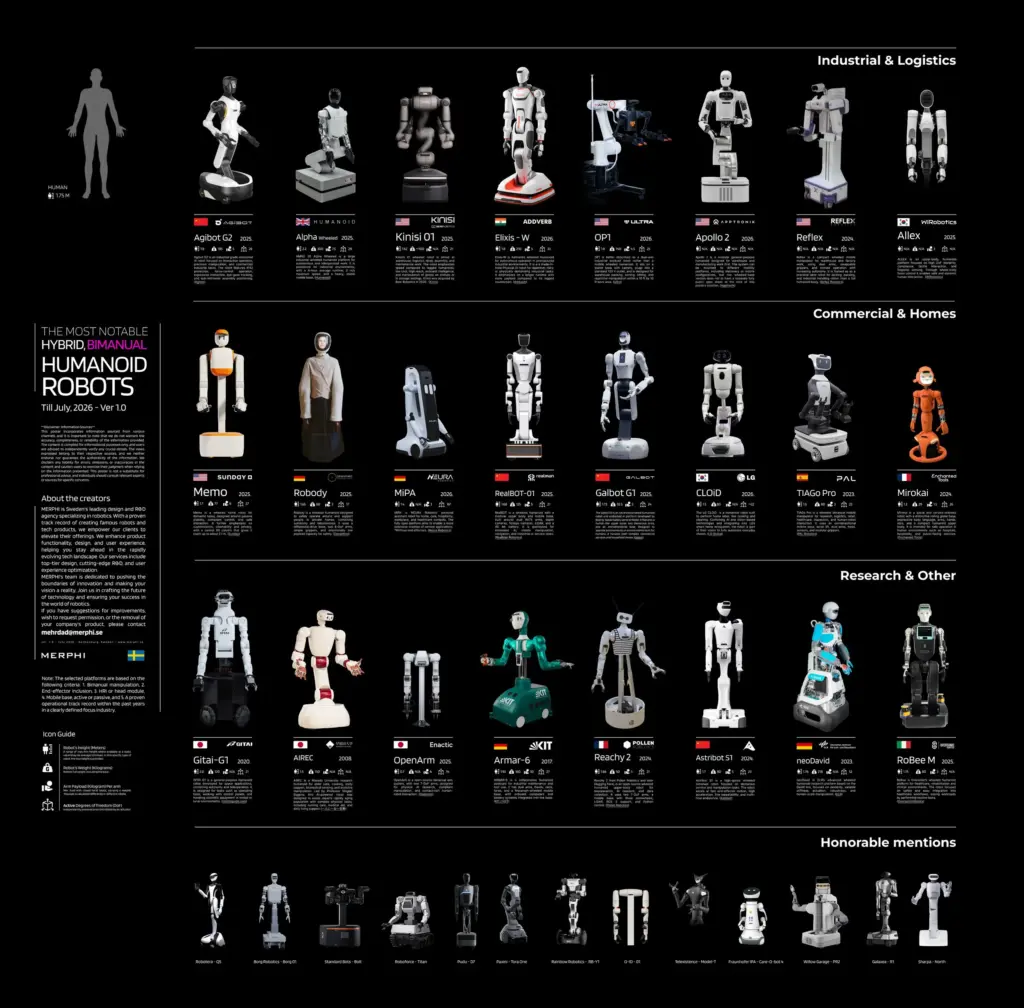
The poster Farimani previewed in Tokyo was subsequently published, and Humanoid Home News covered it in Bimanual wheel-based humanoids gain attention. That later infographic reinforces the design argument he made on stage: for many indoor environments, two useful arms on a stable mobile base may be a practical intermediate step between today’s service robots and fully bipedal home humanoids.
For consumers, the trade-off is straightforward. Wheels can work well on smooth floors and may reduce the mechanical burden of balancing on two legs. They are less suitable for stairs, thresholds and other spaces designed around human walking. Whether that compromise is acceptable will depend on the home and the tasks the robot is meant to perform.
Appearance sets expectations
The session title, How a Humanoid Appears Matters!, reflected another theme in Farimani’s presentation. He separated social and research robots such as human-facing interaction platforms from machines built primarily for physical work, arguing that different categories should not be treated as interchangeable merely because they look humanoid.
That distinction matters in the home. A face, dexterous hands or a humanlike body can signal capabilities to a buyer before the robot has done anything. If the hardware suggests more intelligence, dexterity or independence than the system can reliably deliver, appearance can create expectations the product cannot meet.
Different strategies are shaping the market
Farimani also contrasted U.S. and Chinese humanoid companies, while explicitly acknowledging that he was generalizing. In his view, many U.S. companies are trying to own the full stack from robot design and software through deployment, while many Chinese manufacturers are building hardware platforms that other robotics companies and research groups can build upon.
For home robotics, both strategies could matter. Vertically integrated companies may control the consumer experience more tightly, while modular platforms could accelerate experimentation by letting other developers build household applications on top of existing hardware.
What this means for home humanoids
Farimani’s presentation does not argue that wheeled humanoids will replace bipeds. It shows why the category is attracting attention. If the near-term goal is to move through accessible indoor spaces, reach household surfaces and manipulate everyday objects, a stable wheeled base may solve enough of the mobility problem to let developers focus on arms, hands, perception and useful behavior.
HHN Takeaway: The first broadly useful home humanoids may not need to walk like people. Hybrid wheeled designs could reach homes sooner by reducing locomotion complexity, provided they can navigate real household layouts, manipulate objects safely and deliver enough value to justify their limits.
About Humanoids Summit: Humanoids Summit brings together researchers, robot makers, investors and other leaders working across humanoid robotics and physical AI. Information about upcoming events is available at HumanoidsSummit.com.
Source: Humanoids Summit, “How a Humanoid Appears Matters!,” official YouTube video.
Context: Humanoids Summit Tokyo 2026 official agenda; Mehrdad Farimani poster archive.