Source: Faraday Future and FFR announcement via Business Wire and official launch presentation
Context: Developer and education humanoids, with a home-learning connection
Published: October 15, 2026, 9:15 p.m. EDT, company release; launch event identified as October 14
By Dan Smigrod, Managing Editor, Humanoid Home News
A $2,490 humanoid robot is an attention-grabbing proposition. A $299 model puts the conversation at another price level entirely.
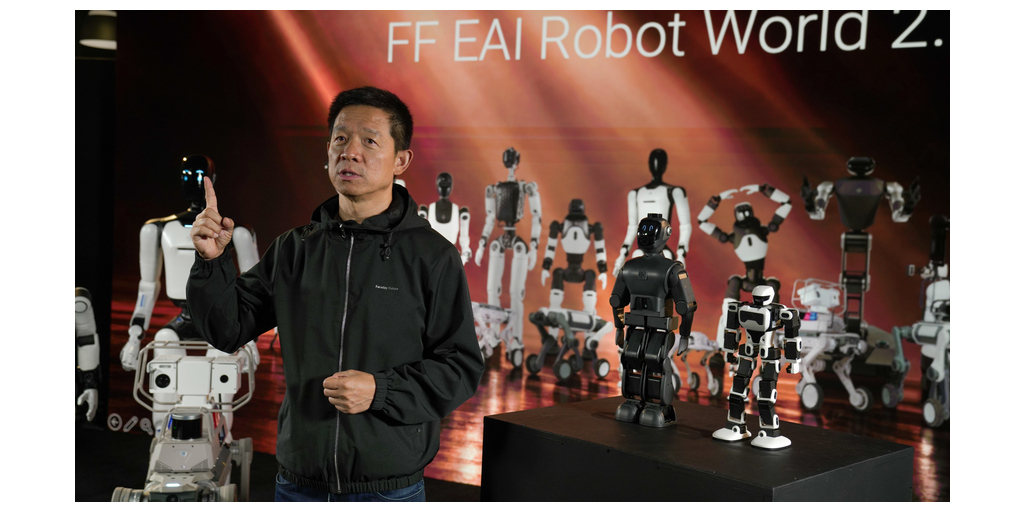
Faraday Future and FF EAI Robotics Ecosystem have announced FF Nova and FF Nova Mini, two small humanoids aimed at different audiences. Nova targets developers and educational institutions. Mini focuses on introductory robotics education, including learning at home.
The prices make this announcement worth examining. They do not mean that a robot capable of taking over household chores has arrived at either price.
FF’s announcement describes Nova as an entry-level embodied AI platform and Mini as a foundational education robot. Their value depends on what buyers want to do: experiment with robot software, learn programming, explore movement or obtain practical help around the house. Those are different purchases.
What the advertised prices include
| Product | Advertised device price | Separately priced offering |
|---|---|---|
| FF Nova | $2,490 USD | Developer Skills Package: $390 |
| FF Nova Mini | $299 USD | Physical AI curriculum: $499 |
Nova’s official shop listing identifies a package containing the robot, MiniCart navigation base, power adapter and Bluetooth controller. The $2,490 figure is advertised as a device purchase price, not a reservation deposit.
The additional $390 developer package would bring the combined advertised price to $2,880. The reviewed material does not clearly establish which capabilities require that package. Buyers should not assume that every advertised development feature is included in the device price.
Tax, shipping and any continuing software, cloud or subscription charges also remain unresolved. Consequently, these figures should not be read as verified all-in ownership costs.
Nova is a development platform, not a full-size housekeeper
Nova’s shop listing gives its height as approximately 497 millimetres, or 19.6 inches, and its robot weight as 2.8 kilograms. It is a compact machine.
FF advertises walking, turning and recovering after a fall, together with interaction and navigation functions. Its detachable base provides another way to move through indoor spaces. The development proposition includes an SDK, ROS 2 support and reinforcement-learning work using NVIDIA Isaac technology.
These capabilities need careful interpretation. Navigating a room is not the same as safely manipulating its contents. Recognizing a person does not establish dependable caregiving. A programmable robot can be useful without being ready to perform unattended domestic work.
The reviewed evidence does not establish Nova reliably doing laundry, preparing meals, cleaning a home or handling comparable chores. Nor does it independently validate FF’s advertised performance.
Availability starts with a restricted launch
FF says Nova’s first phase is invitation-only, limited to 100 units for developers and educational institutions. The company says the first 20 are available for immediate delivery.
That is a company availability statement, not verification that those units have reached customers.
A second phase is intended to open access to developers and educational institutions more broadly. A full consumer launch comes in a later phase. A verified consumer-launch date was not established in the reviewed announcement.
Nova Mini has the more direct home-learning proposition
Nova Mini’s $299 device price is separate from its educational course. FF explicitly says buyers can start with the robot alone.
The optional $499 Physical AI Spark Program comprises 16 live small-group classes over two months. FF positions the learning programme for children and teenagers aged eight and older, including use at home. Course purchasers are promised a voucher toward the robot, but the voucher amount and conditions were not established.
Mini’s advertised activities include programmed movement, turning, getting up, dancing and block-based programming. The official catalog describes a 349-millimetre robot weighing less than one kilogram, with 17 servo joints.
For a family, the relevant question is whether those activities provide engaging, supported learning. That is a credible household use case. It should not be confused with household labour.
Why the price matters, and where the comparison stops
Lower purchase prices can make hands-on robotics accessible to people who would never consider buying a large research platform. They can also change the nature of experimentation: a family might buy a learning device, while a developer might use a small humanoid to explore software and movement.
But affordability is only one part of accessibility.
Documentation, included software, support, repair options and ongoing service costs determine whether an inexpensive robot remains useful after the initial demonstration. For a household buyer, the distinction between a finished feature and a capability that requires programming is especially important.
FF markets Nova as a “first” in the under-$2,500 embodied AI humanoid category. Humanoid Home News has not independently established that comparative claim. The more defensible statement is narrower: FF advertises Nova’s device at $2,490, with an additional developer package priced separately.
What remains to be verified
FF publishes general statements about applicable regulatory compliance and partner hardware. The evidence reviewed for this article does not establish the underlying manufacturer identity or model-specific FCC documentation for either Nova model.
That is an information gap, not a finding of noncompliance. It also means that FF branding should not be presented as proof of where the hardware was manufactured.
For now, the announcement is strongest as a story about the price of entry into embodied AI development and home robotics education. Whether either model becomes a dependable, well-supported household product will require evidence beyond its launch materials.
HHN Takeaway: Humanoid Home News sees an important distinction between buying a humanoid to learn with and buying one to work for you. Nova and Nova Mini offer attention-grabbing entry prices for development and education. Their household value should be judged against those purposes, without treating a low device price as proof of autonomous domestic help.