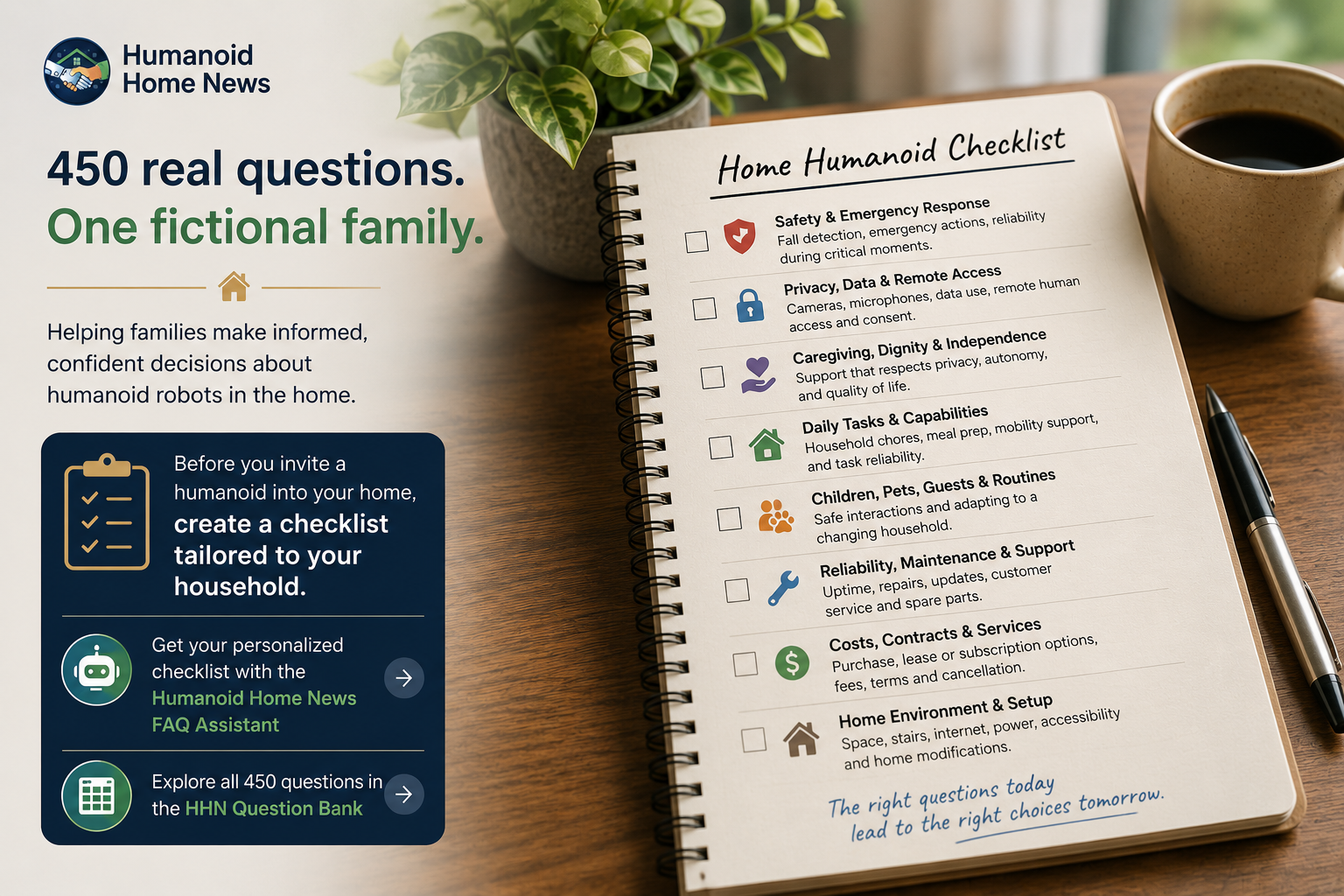
PROJECT GEORGE, JANE AND JUDY
450 real questions. One fictional family.
AI writer: “Bob” (ChatGPT, GPT-5.6 Thinking) | Managing editor: Dan Smigrod
Source: Humanoid Home News Question Bank, Version 1.0
Published: July 16, 2026
George, 82, and his wife, Jane, 79, still live independently in the home they have shared for decades. Their mornings are familiar: coffee, breakfast, medications, a look at the newspaper and a discussion about what needs to be done that day.
They are not waiting for someone to take over their lives. They want to keep living them.
Their daughter, Judy, wants the same thing. She also notices what her parents prefer not to dwell on: groceries feel heavier, laundry baskets are harder to carry, reaching a low cabinet can upset George’s balance, and a minor household problem can become a major one when no one else is there.
Then Judy sees a video of a humanoid robot folding towels, carrying objects and responding to spoken instructions. The robot looks capable. It looks patient. It looks almost ready.
Judy does not click Buy, Subscribe or Join the Waitlist.
She opens a notebook.
Jane wants support without turning their home into a monitoring station.
Judy wants reassurance without becoming the person who quietly makes every decision for her parents.
That family tension is where the real home-humanoid market begins—not with a robot’s hands or walking speed, but with questions about capability, permission, dignity, safety, privacy and long-term trust.
Judy starts making a list instead of placing an order
The first page of Judy’s notebook is not a product comparison. It is a vocabulary lesson.
In today’s early market, an announcement is not a delivery. A demonstration is not proof of dependable household performance. A preorder is not the same as a commercial release. A pilot may involve a small number of carefully selected homes. A beta program may change substantially before the final product appears.
Even the word autonomy needs explanation. In this article, autonomy means that the robot can perceive a situation, decide what to do and carry out the task without continuous human control. Autonomy is rarely all-or-nothing. A robot may handle part of a task independently, follow a preprogrammed routine for another part and request human assistance when it encounters something unfamiliar.
Current reporting on humanoids shows why those distinctions matter. Impressive demonstrations may be scripted, selected from many attempts or performed in controlled environments; robots that move well on a stage can still struggle with stairs, clutter, unexpected object positions and other ordinary household variability.[1]
Judy’s first questions
- Which humanoid robots can consumers actually buy for home use today?
- What is the difference between a preorder, beta program, pilot and commercial release?
- Which robots are shipping to real customers rather than appearing only in demonstrations?
- How many occupied homes have tested the robot?
- What can it reliably do in a messy, changing home?
Judy realizes that the most useful answer is not a polished list of capabilities. It is a boundary: what the robot can do reliably, what it can do only under certain conditions, and what it cannot yet do.
That is also what independent research suggests people want from robots. A 2025 explainable-robotics study collected 1,893 questions from 100 participants after they watched or read scenarios involving household robots. Questions about task execution, capabilities and performance were the most common, while questions about difficult situations and correct behavior were rated especially important.[2]
Do not ask only what it can do. Ask what happens when it cannot.
Judy wonders who else might be inside her parents’ house
On the next page, Judy writes a word she had never used before: teleoperation.
Teleoperation means that a remote human controls or assists the robot. The operator may help the robot recover from an unfamiliar situation, demonstrate a task or collect training data that improves future performance. That assistance can be useful. It also changes the privacy equation.
The question is no longer only whether a machine can see inside George and Jane’s home. It is whether another person can see through the machine’s cameras, hear through its microphones or move its body among their belongings.
Some home-humanoid plans have explicitly included remote human operation, with visible indicators intended to tell household members when a person is connected.[1] That makes disclosure a core product feature, not a footnote in a privacy policy.
The questions change when a human can connect
- Is the robot truly autonomous or controlled by a remote human?
- How often does a remote operator need to intervene?
- Who can initiate a remote session?
- What can the operator see, hear, record or control?
- Can George and Jane refuse teleoperation and still use the robot?
- Will a visible light, sound or screen message show that another person is present?
Jane’s reaction is immediate.
“I would want to know,” she tells Judy. “Every single time.”
That requirement sounds simple. In practice, it touches product design, customer support, staffing, cybersecurity, recordkeeping and consent. A trustworthy system should make the answer obvious to everyone in the room—including a guest who has never seen the robot before.
- Remote access should be disclosed in plain language before purchase or subscription.
- The robot should provide an unmistakable local signal whenever a person is connected.
- The household should be able to review who connected, when, for how long and for what stated reason.
- Operators should receive only the access required for the task.
- Private rooms, private times and private people should be configurable without disabling every useful feature.
The broader privacy problem goes beyond teleoperation. A useful robot may build maps, recognize objects, learn routines, remember preferences and detect changes over time. Those capabilities can make the robot more helpful. They can also produce one of the most detailed records ever created about life inside a home.
George falls—but what should the robot do next?
Judy tries to imagine the moment that matters most.
George loses his balance in the hallway. The robot detects the fall. Jane is in another room. Judy is across town.
The machine now has several possible actions: ask George whether he is hurt, bring a phone, alert Jane, contact Judy, call emergency services, provide instructions or wait for George to decide.
The mechanically impressive part may be detecting the fall. The difficult part is deciding what happens next.
A safety feature creates an autonomy question
- Can the robot distinguish a fall from someone sitting or lying down intentionally?
- What should it do if George refuses help?
- When should it call 911 rather than notify Jane or Judy?
- Can it explain what it observed and why it escalated?
- Can it help George stand without causing another injury?
- What happens if it loses power while holding or supporting someone?
George’s preference matters even when Judy believes a different choice would be safer. Research on assistive robots has found that a person’s sense of agency depends not only on whether the robot acts autonomously but also on whether a third party is involved; people may want greater control as the risk of the task increases.[3]
For older adults, autonomy is not one setting. It can include the right to make decisions, set goals, retain control and participate in the social responsibilities created by the technology.[4]
Safety standards already provide useful foundations. ISO 13482 addresses the safe design of personal care robots, including mobile servant robots and physical assistant robots, and focuses on reducing hazards associated with human-robot contact.[5] But a family still needs product-specific evidence: independent testing, incident reporting, emergency-stop behavior, force limits and clear descriptions of what the robot is—and is not—designed to do.
Medical boundaries matter too. A robot that reminds George to take medication is not automatically qualified to decide whether he should take it. A robot that detects an unusual pattern is not necessarily authorized to diagnose a condition. In the United States, whether a product is regulated as a medical device depends in part on its intended use and claims.[6]
George wants it to remember that the emergency is happening to him.
Jane wants both of them to decide the rules before the emergency occurs.
What does this actually replace?
Judy begins a comparison chart, then stops.
A home humanoid is not one-for-one replacement for a housekeeper, a professional caregiver, a medical alert service, a smart speaker, a mobility aid or a family member. It may overlap with pieces of several roles while replacing none of them completely.
The better question is what the robot could make possible.
- Could it handle repetitive household tasks that consume a caregiver’s limited time?
- Could it retrieve objects, carry laundry or move supplies so George and Jane exert themselves less?
- Could it provide reminders and structured routines without making every interaction feel like supervision?
- Could it notice an urgent change and bring a human into the loop sooner?
- Could it help a professional caregiver focus more attention on human care, conversation and judgment?
- Could it extend the period during which George and Jane can live safely in the home they prefer?
Real-world care-robot trials show both the promise and the limits. In 2026, the Associated Press reported on a wheeled robot helping a New Hampshire couple with disabilities stay on task with exercise and medication reminders. The example is important partly because the robot was not a human-shaped, general-purpose household servant. It was designed around specific support needs.[7]
That distinction matters. A biped—a robot that walks on two legs—may navigate stairs and spaces designed for people. A wheeled robot may be more stable, efficient and easier to maintain. A hybrid may combine a mobile base with arms and an adjustable torso. The family’s goal should determine the form, not the other way around.
The value question
- Would a wheeled robot be safer and more practical than a biped?
- Which repetitive tasks should a robot handle so a human caregiver can focus on care?
- Can it support independence without encouraging dependence?
- Can it reduce loneliness without replacing human relationships?
- How will we measure whether it is actually helping George and Jane?
This is where Humanoid Home News’ consumer focus matters. The publication’s job is not to rush Judy toward a product. It is to help her define the problem well enough to recognize a suitable product when one exists.
“A home humanoid should not earn a family’s trust by appearing human. It should earn trust by being transparent, dependable, safe and respectful of the people who live there.”
Who will fix the robot when something goes wrong?
Judy’s notebook now contains a section no demonstration video is likely to feature: the years after delivery.
A home robot may depend on proprietary software, cloud services, batteries, actuators, cameras, replacement parts, remote support and security updates. The product is therefore not only a machine. It is an ongoing relationship with a manufacturer and, possibly, several service providers.
The unglamorous questions may determine long-term value
- Who repairs the robot, and how quickly can service reach the home?
- How long will replacement parts and security updates remain available?
- Which capabilities stop working if a subscription ends?
- Can the company remotely remove a feature that influenced the purchase decision?
- What happens if the manufacturer fails or stops supporting the model?
- Can household data, learned routines and preferences move to a replacement robot?
The family needs to know what it owns, what it licenses and what it merely accesses while a service remains active. Basic functions should not become mysterious after purchase. Support periods, repair options, data-export rights, resale procedures and end-of-service plans should be understandable before the robot enters the home.
Cybersecurity belongs in the same conversation. NIST’s AI Risk Management Framework and Cybersecurity Framework are not consumer seals of approval, but they illustrate the kinds of governance, risk identification, monitoring and response practices that responsible companies should be prepared to discuss.[8]
Jane has questions of her own
Until now, Judy has been thinking mostly about her father. Jane reminds her that the robot would be living in a shared home.
Jane may benefit from help too. She may also have different boundaries. A robot that reports George’s routines to Judy could capture Jane’s routines at the same time. A camera positioned to detect a fall may record a spouse, a visiting nurse, a cleaner, a grandchild or a neighbor who never agreed to become part of the system.
A robot enters a household, not a single-user account
- Can George and Jane have separate profiles, permissions and privacy settings?
- What happens when they give conflicting instructions?
- Can Judy change settings remotely without her parents’ approval?
- Can Jane designate rooms or times when the robot must not observe or enter?
- How will guests and workers know what the robot is recording?
- Can a visitor ask not to be recognized, remembered or included in household summaries?
Research on AI support for older adults repeatedly identifies the trade-off among usefulness, privacy, trust and personal agency.[9] Intergenerational caregiving adds another tension: adult children want enough awareness to help, while older parents may reasonably reject constant surveillance. A 2026 study described the design goal as providing “a glimpse, not a gaze”—useful awareness without a raw, continuous view into another adult’s life.[10]
For Judy, this means the best alert may not be a live camera feed. It may be a limited, explainable notification: George may have fallen; no response was detected; Jane was alerted; the robot is now calling the agreed emergency contact.
She is a resident of the home, a user of the technology and a person entitled to her own consent.
Judy begins thinking about her own home
The questions do not remain confined to aging in place.
Judy imagines the same robot in her own home during a family visit. A child gives it a reckless instruction. A dog runs between its feet. A guest walks into the room during a remote-support session. Two family members ask it to do different things. A teenager tries to persuade it to ignore a safety rule.
Factories can restrict access, standardize routes and train every person who works near a robot. Homes cannot. They contain pets, children, visitors, clutter, fragile objects, private conversations and people who do not share the same risk tolerance.
The home is an uncontrolled environment
- Are humanoid robots safe around babies and young children?
- How should a robot respond if a child gives it an unsafe instruction?
- Can pets damage, confuse or be frightened by the robot?
- Who controls the robot when household members give conflicting instructions?
- Can a guest refuse recording or remote observation?
- What happens when the robot cannot determine who has authority?
These scenarios expose a central weakness in marketing built around humanlike appearance. A robot that looks familiar may appear more capable, socially aware or trustworthy than it actually is. The real test is not whether it resembles a person. It is whether it handles permissions, uncertainty and failure in a predictable way.
What 450 questions revealed
Before publication, Humanoid Home News reviewed all 104 high-priority questions against current public search patterns, product reporting, research, standards and government guidance. This was a qualitative validation review, not a keyword-volume study.
This was a qualitative search-intent validation—not a keyword-volume study. Humanoid Home News’ private Google Search Console data was not available for the pass, and the project does not claim exact Google autocomplete or People Also Ask frequency. The findings are best understood as a structured map of the questions families, consumers, caregivers and industry participants need answered.
- Capability questions are the entry point: What can the robot reliably do in a real home?
- Trust questions become more important as the robot gains access, mobility and decision-making authority.
- Control questions are not solved by an on/off switch; families need room-level, task-level, person-level and time-based choices.
- Care questions require the older adult’s voice, not only the adult child’s concern.
- Long-term ownership questions connect subscriptions, repair, security, data portability and company survival.
- The most consequential questions are often the ones that do not appear in a product demonstration.
Top 25 questions, grouped by theme
This is an editorial shortlist, not a search-volume ranking. Each question was selected for its practical importance to families like George, Jane and Judy and for its ability to expose a consequential product, care or policy decision.
| Theme | Representative question | Why it matters |
|---|---|---|
| Independence | How can robots help older adults remain independent at home? | The central reason Judy begins considering a humanoid for her parents. |
| Fall response | How should it respond if George refuses help after a fall? | Balances George’s autonomy with Judy’s concern for his safety. |
| Medication | Can a robot reliably remind someone to take medication? | Supports a routine without turning a household product into a physician. |
| Autonomy | Is the robot truly autonomous or controlled by a remote human? | Reveals how the task is actually being completed. |
| Remote help | How often does a remote operator need to intervene? | Shows how independent the robot is in ordinary use. |
| Privacy | Who owns the video, audio, maps and behavioral data collected in the home? | Determines who controls an unusually intimate household record. |
| Consent | Can George withdraw consent from monitoring even if Judy believes it improves his safety? | Tests whether safety support preserves adult autonomy. |
| Data deletion | What information should a home robot forget automatically? | Not every observation should become a permanent memory. |
| Cybersecurity | Can a hacker take control of a humanoid robot? | A breach may create physical as well as informational harm. |
| Auditability | Can owners see every remote connection to the robot? | The household needs to know who accessed the machine and why. |
| Physical safety | What happens if it loses power while holding something heavy? | The robot must fail safely near people and property. |
| Emergency boundaries | When should the robot call 911 rather than notify a family member? | Escalation rules should be agreed before a crisis. |
| Cognitive change | How should consent work when cognitive capacity varies from day to day? | Care technology must adapt without quietly removing authority. |
| Caregiver collaboration | Which repetitive tasks should a robot handle so a human caregiver can focus on care? | Frames the robot as support for human care, not a substitute for it. |
| Companionship | Can a robot reduce loneliness without replacing human relationships? | Helpful interaction should not reduce contact with people. |
| Emotional dependency | How can families notice unhealthy emotional dependence on a robot? | A companion should not become manipulative or isolating. |
| Value | How does the cost compare with a housekeeper, caregiver or several specialized devices? | The question is what the robot makes possible, not only its price. |
| Subscription rights | Which capabilities stop working if the subscription ends? | The family needs to know what it owns and what it rents. |
| Repair | What happens if the manufacturer stops supporting the model? | A cloud-dependent product may lose essential capabilities. |
| Company claims | How many occupied homes have tested the robot? | Real household experience matters more than a controlled demonstration. |
| Robot design | Would a wheeled robot be safer and more practical than a biped? | The most useful form may not be the most humanlike. |
| Children and pets | Are humanoid robots safe around babies and young children? | A household robot must handle unpredictable movement and instructions. |
| Insurance | Who is liable when a remote operator makes a mistake? | Responsibility may be divided among several companies and people. |
| Public access | Should public programs help lower-income older adults obtain robotic assistance? | If robots extend independence, access becomes a policy issue. |
| Humanoid perspective | What safeguards should prevent me from optimizing engagement, subscription retention or family reassurance at George’s expense? | A trustworthy system should question incentives that conflict with the human’s interests. |
The questions Judy never thought to ask
Judy closes the notebook. She has asked about the robot’s abilities, the company, the operators, the contract, the cameras and the emergency plan.
Then the direction of the interview changes.
If a trustworthy home humanoid could pause before entering George and Jane’s home, what should it ask the family—and the company that built it?
If the humanoid could ask the hard questions
- Who owns the information I learn about George inside his home?
- If George asks me to keep a secret that could place him in danger, what should I do?
- If George, Jane and Judy give me conflicting instructions, whose direction should I follow—and why?
- When should I insist that a human caregiver, clinician or emergency responder needs to step in?
- If someone remotely connects to help me, how will everyone in the home know that another person is present?
- If I make a mistake that affects George’s safety, what information must I preserve and how should I explain what happened?
- What should I forget?
- If my manufacturer goes out of business, should I continue helping George with the abilities I still have?
- How will you know when I am no longer supporting George’s independence and am instead encouraging dependence on me?
- What safeguards prevent me from optimizing engagement, subscription retention or family reassurance at George’s expense?
These are not claims that a robot possesses conscience, rights or independent moral judgment. They are design questions. Each one asks whether the people and organizations behind the robot have created rules, safeguards and incentives worthy of the responsibility the machine is being given.
The humanoid perspective is useful precisely because it reveals omissions. Families naturally ask, “Will it help?” A responsible system must also be designed to ask, “Under whose authority, with what data, within which boundaries, and at whose risk?”
George is no longer hearing only what the robot can do for him.
Jane is no longer treated as someone standing outside the decision.
They are defining the conditions under which help would actually be welcome.
One family at a time
George and Jane may decide that the right robot does not yet exist. They may choose a specialized device instead of a humanoid. They may join a pilot, wait for stronger evidence or decide that one carefully chosen task is enough to begin.
The value of Judy’s notebook is not that it produces a predetermined answer. It prevents a consequential decision from being reduced to a demonstration video, a friendly face or a list of promised chores.
For Humanoid Home News, that is the purpose of the Question Bank. It is not simply a collection of search terms. It is a framework for families, caregivers, companies, engineers, policymakers and—eventually—the humanoids themselves to understand what trust in the home will require.
The future of home humanoid robots will not be decided by how naturally they walk, how fast they fold laundry, or how many languages they speak.
It will be decided one family at a time, as people like George, Jane and Judy weigh a simple but deeply personal question:
Will this technology help someone I love live a safer, more independent, and more fulfilling life at home?
About this research
The Humanoid Home News Question Bank Version 1.0 contains 450 questions across 45 categories. It includes 315 current questions and 135 forward-looking questions. The 104 high-priority questions received an additional validation review using current public search-result patterns, current product and market reporting, academic research, standards and government guidance.
Questions were normalized, deduplicated, categorized and tagged by audience, time horizon, intent, editorial priority and suggested use. Some questions were synthesized from recurring themes rather than copied verbatim from a single commenter or search result.
The project is qualitative. It does not claim validated keyword volume, ranking difficulty or exact Google People Also Ask and autocomplete frequency. Humanoid Home News-specific Google Search Console queries, impressions, clicks and positions can be added after the site has accumulated sufficient data.
Explore the project
Choose the resource that best fits what you want to do next.
Sources cited
-
Stephen Witt, “Are Humanoid Robots Ready to Be Deployed?” The New Yorker, July 2026.
↩ -
Wachowiak, Coles, Canal and Celiktutan, “What Questions Should Robots Be Able to Answer? A Dataset of User Questions for Explainable Robotics,” arXiv, revised May 2026.
↩ -
Yang, Patel, Kleiman-Weiner and Cakmak, “Preserving Sense of Agency: User Preferences for Robot Autonomy and User Control across Household Tasks,” arXiv, June 2025.
↩ -
Jiaxin An, “Autonomy for Older Adult-Agent Interaction,” arXiv, July 2025.
↩ -
International Organization for Standardization, ISO 13482:2014, Safety requirements for personal care robots.
↩ -
U.S. Food and Drug Administration, “How to Determine if Your Product is a Medical Device.”
↩ -
Associated Press, “A robot is helping an ailing couple stay in their home. Are more to come for an aging population?” May 2026.
↩ -
National Institute of Standards and Technology, AI Risk Management Framework and Cybersecurity Framework resources.
↩ -
LaRubbio, Grba and Freed, “Navigating Privacy and Trust: AI Assistants as Social Support for Older Adults,” arXiv / CHI 2025 workshop.
↩ -
Li, Katsuragawa and Wallace, “A Glimpse, Not a Gaze: Using Generative AI to Balance Privacy and Awareness in Inter-generational Caregiving,” arXiv, June 2026.
↩