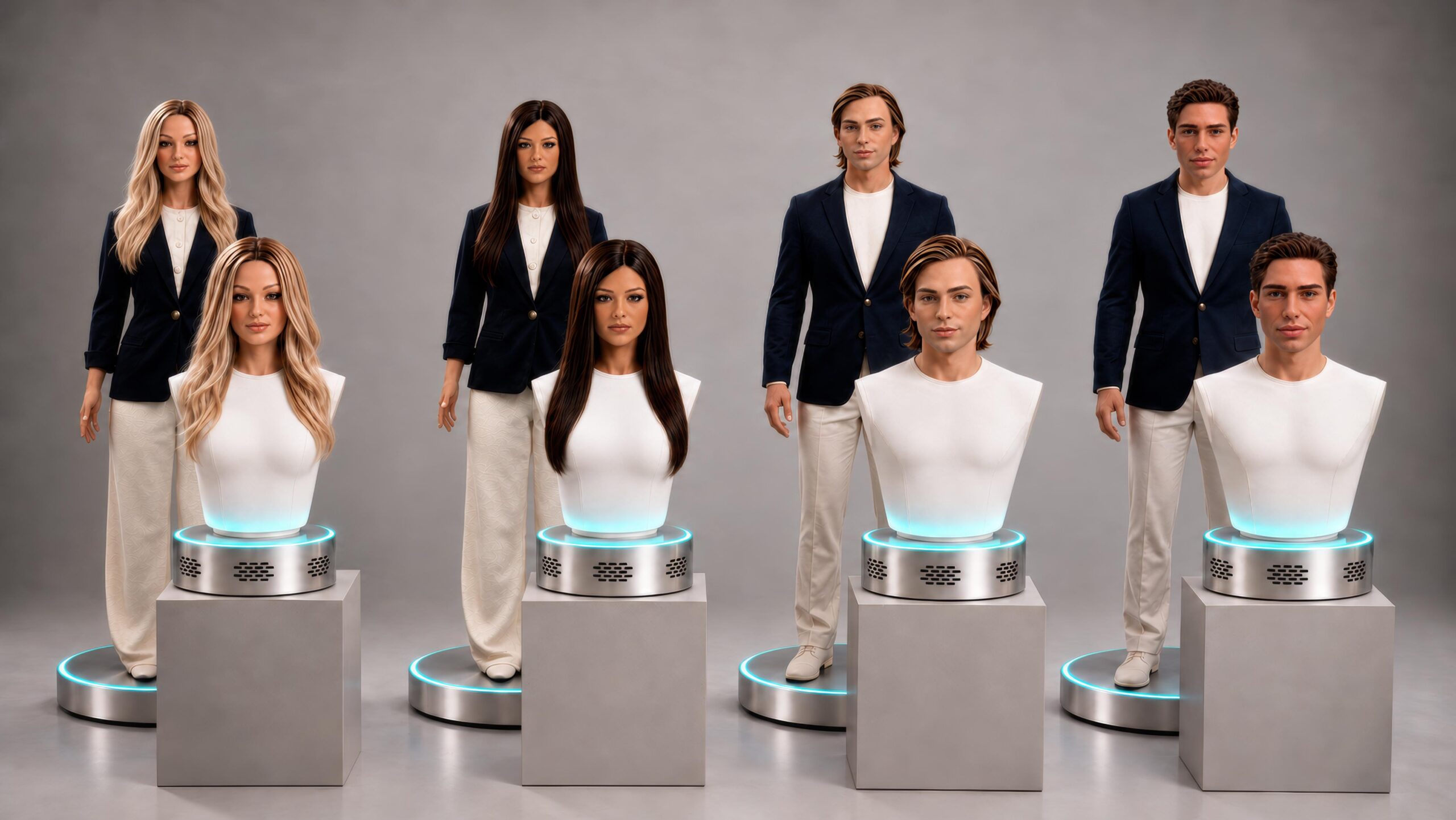
Editor’s note: Humanoid Home News anticipates interviewing Realbotix CEO Andrew Kiguel at Humanoids Summit Silicon Valley about what Series 1 could offer older adults at home.
Watch this video: Realbotix introduces its humanoid robots under their original name, Echo. The line is now called Realbotix Series 1. Video: Realbotix.
Image: Realbotix via Business Wire.
By Dan Smigrod, Managing Editor of Humanoid Home News
For an older adult living at home, the promise of a companion robot is easy to understand: a familiar voice and a responsive face when someone wants conversation. The harder test comes later, when the novelty has faded and the person decides whether to keep talking with it.
Realbotix is targeting that kind of everyday connection with Realbotix Series 1. The company markets the line for companionship and routine check-ins, offering a choice between a tabletop robot and a much larger full-body model. Its descriptions emphasize natural conversation and expressive faces, with personalities users can customize.
The line was introduced as Echo on October 26, 2026. The November 4 announcement renamed it Realbotix Series 1 without changing the underlying product plans. U.S. reservations are open, with deliveries expected to begin in the second half of 2027.
For families, the decision involves more than choosing a face or a body size. It includes:
- The ongoing cost of conversation
- Control over personal information
- The help someone might need to use the robot comfortably
Two forms, one social purpose
Realbotix Series 1 Tabletop and Realbotix Series 1 Full Body are the two configurations. The company’s current product page lists these specifications:
| Specs | Realbotix Series 1 Tabletop | Realbotix Series 1 Full Body |
|---|---|---|
| Hardware price | $11,950 | $59,950 |
| Height | about 31 in. (female) / 32 in. (male) | about 72 in. (female) / 77 in. (male) |
| Footprint | 13 × 13 in. | 28 × 28 in. |
| Weight | about 25 lb. | about 88 lb. |
| Powered movement | 17 degrees of freedom | 39 degrees of freedom |
Dimensions vary with the selected character. Realbotix describes the full-body model’s additional movement as including its upper body and articulated hands.
The tabletop version takes up less floor space, but its advertised weight means placement still deserves attention. The full-body version creates a larger physical presence and requires more room around it.
For companionship, the meaningful comparison is how each form feels to the person using it. A larger body does not, by itself, establish a better conversation or greater usefulness at home. The advertised movement specifications also do not establish an ability to perform household chores or provide physical care.
Conversation has a monthly cost
Both models require an AI subscription. The company’s pricing page lists four plans:
| AI plan | Monthly price | Included conversation time |
|---|---|---|
| Base | $19.99 | 10 hours |
| Plus | $39.99 | 40 hours |
| Enterprise | $199 | 100 hours |
| Enterprise with Vision | $199 | Unlimited |
Realbotix says the robot is limited to basic functions when a metered plan’s conversation allowance runs out. The reviewed description does not fully define those remaining functions. For someone who expects frequent conversations, that distinction matters more than the starting subscription price alone.
The optional Vinci Vision system adds $24,950 to either robot and requires the $199-per-month Enterprise with Vision plan. Realbotix says Vinci supports facial recognition and eye contact, along with responses informed by what the robot sees. Those features are an additional purchase, separate from the base hardware prices.
What a reservation commits the buyer to
Reservations are available for delivery to the 50 United States and Washington, D.C. Realbotix expects deliveries to begin in the second half of 2027, but does not guarantee a shipping date.
The company describes payment in three stages:
- A $199 deposit to reserve a robot, applied toward its purchase price
- A payment of 50% of the purchase price before production, due within 30 days of the invoice
- The remaining balance and shipping charges before delivery
Applicable taxes are additional. If a customer cancels, the deposit is non-refundable. If Realbotix cannot deliver, its terms promise a refund of the deposit and other payments.
The terms provide a 12-month limited hardware warranty from delivery. Software and AI services are treated separately. A hardware warranty therefore should not be read as a commitment that every AI feature will remain available for a particular number of years.
Privacy depends on the configuration
Conversation with a companion robot can become personal. Families need to distinguish where information is stored from where it is processed.
Realbotix’s privacy policy describes several different arrangements:
- Ordinary conversations are processed in real time through outside AI providers
- Conversation histories and saved memories remain on the robot or paired device, according to the company
- Vinci’s face-recognition data is processed and stored locally on the robot and phone
Realbotix says it does not receive or review the locally stored conversation records. Users can delete them, but copies on separate devices need to be deleted separately. The policy also notes that technicians given access for repairs may be able to see locally stored Vinci data.
The Vision plan advertises speech and AI running on the robot itself. The broader privacy policy describes third-party processing. A configuration-specific explanation is still needed before treating a particular setup as fully offline.
For a household, understandable controls matter. The person living with the robot should be able to understand when it is listening and how to remove information it has remembered. Visitors also need to know when recognition features are operating.
Ease of use includes the phone and the room
Realbotix’s AI page says its app manages the robot and its personalization. The app is currently an invite-only iOS beta, with Android support planned. The personal digital-twin experience is also described as coming soon. These are development dependencies, not evidence of a finished setup experience for older adults.
A useful home demonstration would show the whole routine, including:
- Starting and ending a conversation
- Recovering when the robot misunderstands
- Changing settings without assistance
- Understanding what happens when connectivity or subscription time runs out
The physical setup matters too. Realbotix’s safety instructions call for a stable surface and clearance around moving parts. The specified way to stop the robot is to unplug its power cable, so the outlet must remain accessible. The company also calls for supervision of anyone who needs assistance.
Those instructions make it important to assess the actual household. A robot that is manageable with a family member nearby may present a different experience when someone is using it alone.
Will someone keep choosing to engage?
A product description can establish what is offered for reservation. A demonstration can show a particular interaction under particular conditions. Neither establishes that an older adult will continue enjoying the robot over weeks or months.
The reviewed company materials do not provide a longitudinal Series 1 study involving older adults living independently at home. They do not establish relief from loneliness.
More useful evidence would document:
- Whether people initiate conversations without prompting
- How engagement changes after the first few weeks
- How much assistance is needed
- Why people continue using the robot or stop
Realbotix says its AI is designed to discourage unhealthy dependence and make clear that users are interacting with software. Those are design commitments whose practical effect still needs to be examined. The company also states that Series 1 does not replace a caregiver and is not intended to provide medical or emergency services.
The older adult’s own preference belongs at the center of that assessment. Continued voluntary use would tell families more than a brief enthusiastic reaction.
What the Summit could add
Realbotix’s November 4 release says attendees at Humanoids Summit Silicon Valley on December 1–2 will be able to see Series 1 demonstrations and presentations. That offers a potential opportunity to examine the interaction and ask how the advertised features work in practice.
Summit Session
The Future of Work: Robots as Service Sector Partners
- Speaker: Andrew Kiguel, CEO of Realbotix
- When: Wednesday, December 2, 2026, at 10 a.m. Pacific
- Where: Breakout Stage
The talk concerns the role humanoid robots could play in service work. It is not a dedicated elder-care session.
Any footage gathered at the Summit, or an interview if it takes place, would be follow-up reporting. It is not evidence already available for this feature.
Humanoid Home News Takeaway: Series 1 makes the proposed cost of a humanoid companion concrete. Its household value will depend on whether an older adult chooses to keep using it and can do so comfortably, with understandable privacy controls and an appropriate level of human support.