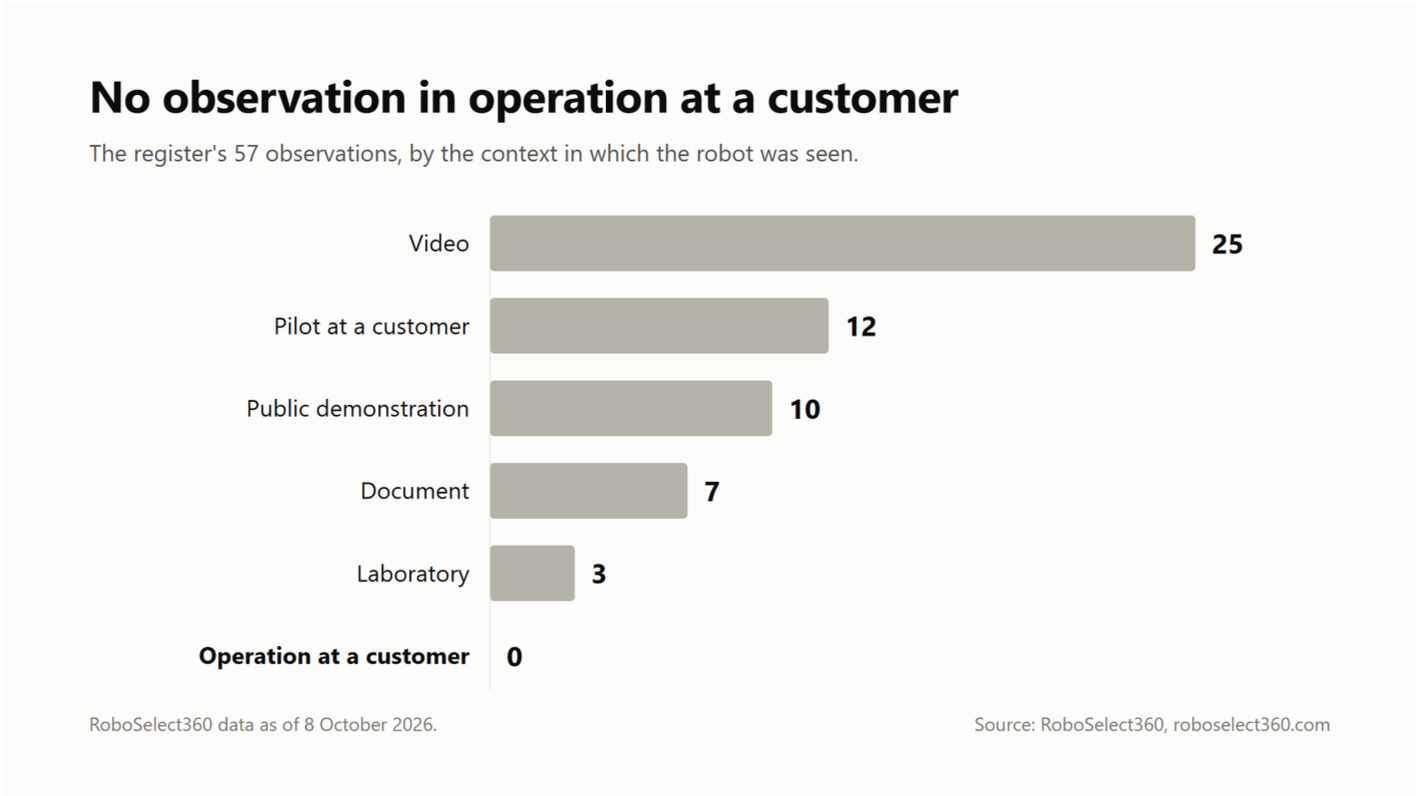
Source: RoboSelect360, Beyond the Demo: The Real State of Humanoid Robots, 2026
Context: HHN analysis of an October 2026 report covering home and industrial humanoids
Published: October 2026 (report); data recounted October 8, 2026
Related: LinkedIn post
By Dan Smigrod, Managing Editor, Humanoid Home News
A robot folds a shirt. The video ends. For someone considering a humanoid for the home, the important questions are just beginning.
Will the purchased robot perform that task without a person steering it? What happens when it gets stuck? And who fixes it when something breaks?
An October report from RoboSelect360 offers a useful starting point. Its broader assessment of humanoid robots examines the distance between demonstrations and dependable use, along with gaps in component disclosure and ownership costs. For households, the practical lesson is to ask for evidence tied to the robot and software they would actually receive.
What the report establishes
RoboSelect360 sells robot analysis and decision-support services. This article examines its report; Humanoid Home News has not independently audited the underlying observation register.
RoboSelect360 says its register contained 57 dated observations involving 15 robots, with figures recounted on October 8. That is a mixed-use sample, not a survey confined to home humanoids.
Among 44 observations showing complete or partial task success, the report classified 17 as manufacturer-stated autonomous, three as teleoperated and 24 as having an unspecified control mode. Those labels describe what the sources disclosed. They are not independent tests of autonomy.
The report also acknowledges that its search is not systematic. A capability absent from its register is therefore undocumented in that register, not necessarily unavailable anywhere.
For a home buyer, that distinction matters. An unanswered question calls for better evidence. It does not justify assuming either success or failure.
Ask about the ordinary day
A demonstration can show a useful skill. Household usefulness depends on what happens between demonstrations.
Ask the seller to describe a complete task: how the robot starts, what assistance it needs, how it handles unfamiliar objects and what happens after an unsuccessful attempt. Request results across repeated attempts, including interventions and failures, rather than a selection of successful clips.
Then connect those results to your own home. A shirt on a clear table presents a different challenge from a mixed laundry basket beside furniture, pets or children. Ask which conditions were tested and which remain outside the intended use.
If remote assistance is part of the service, establish when it is used, what an operator can see, how permission works and whether the assistance costs extra. These are purchasing questions, not claims that every robot uses the same arrangement.
Buy the delivered capability
Ask which software version demonstrated the task and which version comes with the purchase. Separate capabilities included at delivery from planned updates.
The same discipline applies to support. Before placing an order, request the warranty, repair process, replacement-part arrangements and expected response times in writing. Establish what happens if the robot needs to leave your home for service.
A purchase price alone cannot answer those questions. List the recurring charges and services the seller requires, then consider your own time spent supervising, preparing rooms or recovering failed tasks. The report's industrial return-on-investment calculations should not be treated as household savings estimates.
A useful answer can include limits
A seller who identifies an unsupported task gives a household something it can plan around. A promise without a delivery date or test conditions does not.
The purchasing decision becomes clearer when every claimed benefit has a corresponding piece of evidence, a stated limitation and a support commitment. That is how a compelling demonstration becomes an offer a family can evaluate.
HHN Takeaway: Ask what the robot you will receive can reliably do in your home, how much help it needs and what support follows the sale. A clear answer is more useful than another impressive clip.