(Editor’s Note: The following guest commentary is by Nicolas Grunder, Founder of RoboSelect360 based in Paris, France.)
Every week brings a new clip of a humanoid folding a shirt or loading a dishwasher. Each one looks like a step toward a robot in your kitchen. But a clip answers less than it seems to. Was the robot acting on its own, or was someone steering it? Was this the first try, or the best of fifty? Is the software in the video the software that ships?
At RoboSelect360 we log, one by one, what humanoid robots have actually been seen doing. Each observation is dated and sourced, failures are included, and a manufacturer’s promise is never taken as proof. Here is what the home looks like as of 5 October 2026.
The short version
We found 15 observations of household tasks, across 4 robots: Unitree G1, Figure 03, 1X NEO and XPeng IRON.
That is a small number, and the size is itself a finding. For all the attention home humanoids get, the public record of them doing housework is thin.
Who is at the controls?
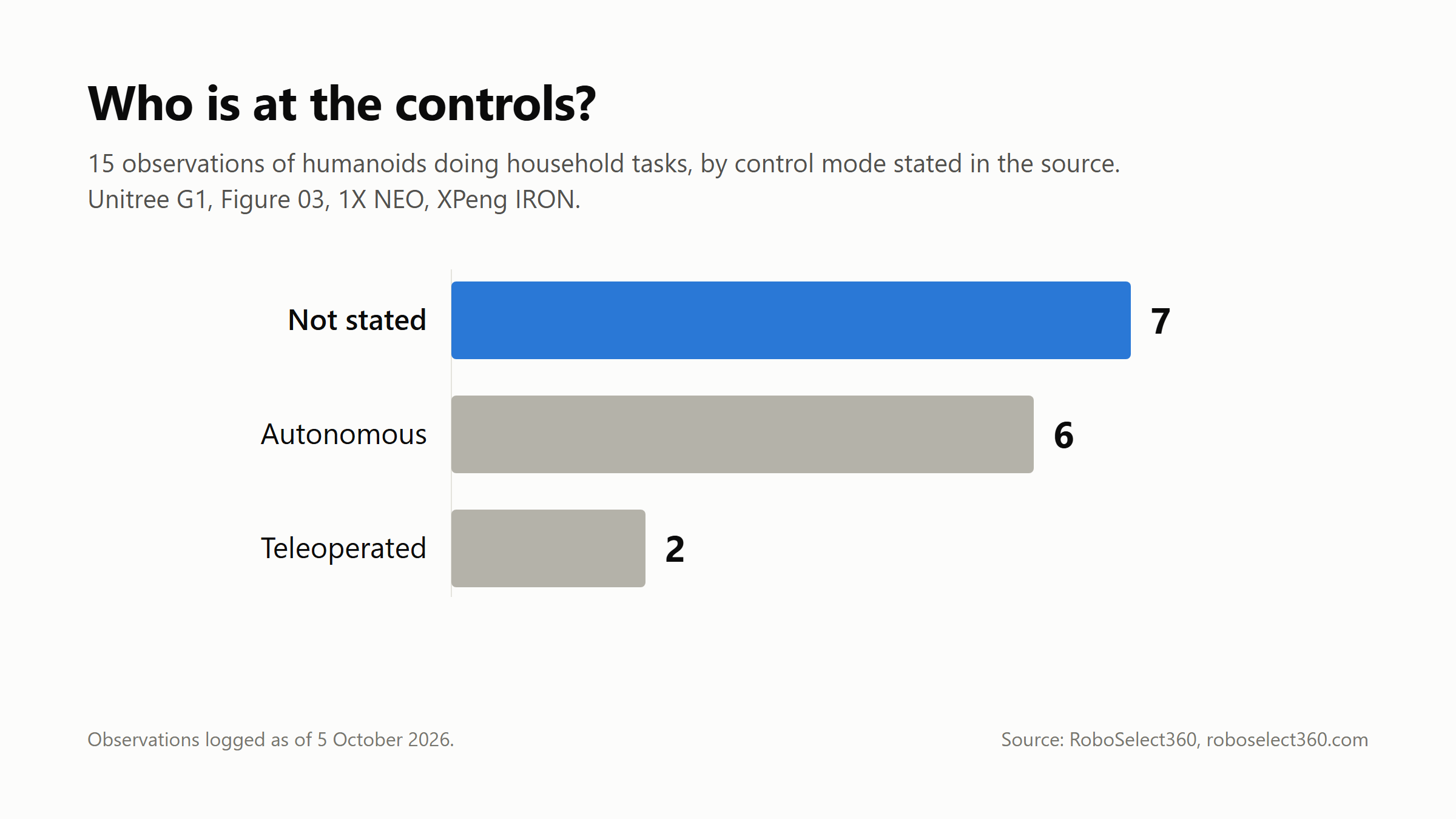
This is the question most videos leave open:
- 6 of the 15 observations state that the robot was acting autonomously.
- 2 were explicitly teleoperated, with a person piloting the robot remotely.
- 7 do not say either way.
The distinction matters. A teleoperated demo proves the hardware can physically do the task: the hands are dexterous enough, the arms strong enough. It proves nothing about whether the robot can decide and act alone. For a home robot that is the whole question, because nobody buys a robot to then pilot it themselves.
When nearly half the record does not say who was driving, the viewer fills the gap, usually in the robot’s favour.
The robot you can buy, and the robots that film best
The 1X NEO is the only robot in this group designed and sold for the home. Its household tasks were shown during a press visit in October 2025, on a unit earlier than the shipping model: a shirt folded acceptably but with a sleeve hanging out, and three items loaded into a dishwasher in five minutes. Both were teleoperated. Tidying was promised at launch, with no demonstration we could assess. As of our search on 2 October 2026, we found no NEO video of a household chore with stated autonomy.
Meanwhile, the clearest autonomous household clips come from robots that are not sold for homes. Unitree’s G1 is a research platform; it has been filmed tidying a room, loading a dishwasher and gathering laundry. But in each case it was running a research model that Unitree does not ship with the robot.
What you see is not quite what you buy, in both directions.
The chores that film well, and the ones that matter
Laundry, dishes and tidying account for 13 of the 15 observations. These are visual, contained tasks: a clear start, a clear end, a good shot.
Now look at what is missing. We searched for a robot fetching an object from another room (on four robots), receiving a parcel, watching over the home, calling for help in an emergency, and supporting a person while they walk. We found no observation of any of them.
Those are exactly the capabilities that would justify a humanoid in the home of an older person, the market most often cited to explain why home humanoids matter. Several of them also cannot be proven by a video at all: you only know a robot reliably calls for help when someone has fallen by watching it do so over months, in real homes.
No observation comes from a customer’s home
Of the 15 observations, none was made in the home of a paying customer:
- 11 are manufacturer videos
- 2 are public demonstrations
- 1 is a launch announcement
- 1 is a structured test run by a manufacturer
Every video carries the same caveats in our log: a single trial shown, success rate not published.
The one number worth reading closely
The exception is Figure. In September 2026 it published a blind evaluation of Figure 03 in 30 homes in the Bay Area, where it had collected no data beforehand: tidying a living room, folding towels, making a bed. The result was 56% success overall. Success criteria were strict (every toy in the basket, for instance), and a human intervention needed for safety counted as a failure.
That is the closest thing to evidence in the whole home record, and it deserves credit: the definition is strict and the number is not flattering. It is still measured by the manufacturer, with no per-task rate and no number of trials published. And read plainly, it says that a bit less than half the time, the job was not finished without help.
Four questions to ask of any home robot video
- Was it autonomous? If the video does not say, assume it was not.
- How many tries? One success shown is not a success rate.
- Which software, and does it ship? A research model in a lab is not the product in the box.
- In whose home? A staged set, a rented house and a customer’s living room are three different claims.
Home humanoids may well get there. But the honest state of the record in October 2026 is that we have seen them do a few photogenic chores, mostly on camera, often without being told who was in control, and never yet in a customer’s home over time.
RoboSelect360 tracks what humanoid robots have actually been seen doing, robot by robot, with every dated observation and its source. More at https://roboselect360.com/en/
Editor’s Note: Nicolas Grunder is the founder of RoboSelect360, based in Paris, an independent intelligence platform on humanoid robots. It covers 34 robots (and more to come) across what they have actually been seen doing, their component-level teardowns (electronics, mechanics, software), their supply-chain dependencies, the cost of deploying them, and EU regulatory readiness.